

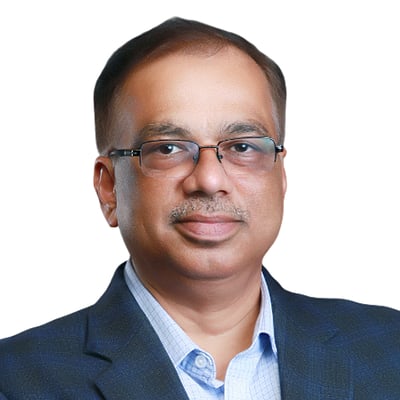
Ketan Gaikwad
Managing Director & Chief Executive Officer
Receivables Exchange Of India Limited
Mr. Ketan Gaikwad, the Managing Director and CEO of Receivables Exchange of India Limited (RXIL), is a banker with a career spanning 3 decades.
Prior to joining RXIL, he has held leadership roles in transaction banking in Barclays Bank and Standard Chartered Bank. He started his career with Bank of Baroda and has had multiple roles in Standard Chartered before heading trade finance in Barclays Bank.
Mr. Ketan Gaikwad is science graduate from Mumbai University and has a Master’s Degree in Management Studies from Symbiosis Institute of Business Management, Pune. He has completed Executive Leadership Program from INSEAD, Fontainebleau, France, and advanced Programme on Fintech from IIM Kolkatta.
Speaking at SFF 2026
-
1:15–1:45pmFri 20 NovCatalyst StageHall 3, Singapore EXPOOpen
Others
Asia’s Interoperable Green Economy: The Leap from National to Regional
About this session
Sustainability data is no longer just a reporting requirement. As the impacts of climate change become more pronounced, trusted data on ESG performance will increasingly shape who companies buy from, who banks finance, and where capital flows. · But sustainability data remains difficult to generate, difficult to exchange, and difficult to translate into the commercial decisions it ought to inform. SMEs, which make up the overwhelming majority of businesses across Asia, often lack the motivation, time, resources and financial capacity to get started. Those that do face fragmented requirements, limited guidance and repeated requests for similar information from different customers, financiers and regulators. Across Asia, governments, development institutions, and major private-sector fintechs are rising to the challenge. o In Singapore, the public and private sectors are collaborating on common digital infrastructure that underpins nationwide activation of “queen bees” and their supply chains, under the Green 100 movement. o The Philippines is similarly exploring how publicly listed companies can mobilise suppliers for Scope 3 reporting, ahead of their mandatory Scope 3 timelines; o India is examining how inclusive and simplified disclosures can enhance SMEs’ access to green marketplaces globally and strengthen access to green trade financing from banks. A common ambition cuts across these efforts – the shared desire to move from reporting towards reusable economic infrastructure, in which trusted sustainability data is generated once, but put to work repeatedly across compliance, supply chain, procurement, and financing use cases. · This dialogue brings together the SEC Philippines, ADB, and RXIL to explore the steps needed to make this transition real. Who builds the rails? What gets businesses onto them? Where does public infrastructure end and private innovation begin? And can these emerging national approaches ultimately connect to forge a more interoperable green economy across Asia?


