

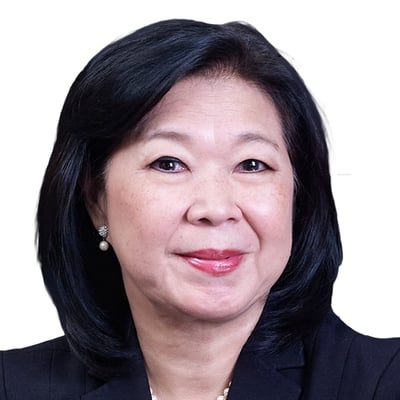
Filianingsih Hendarta
Deputy Governor
Bank Indonesia
Filianingsih Hendarta earned her bachelor's degree in Law from Airlangga University in 1985 and her master's degree in Economics and Finance from Boston University in the United States in 1992.
She began her career at Bank Indonesia in 1986. Prior to her appointment as Deputy Governor, she served as Assistant Governor responsible for payment systems, where she played a key role in advancing Indonesia's national payment system transformation. Throughout her distinguished career, she has held several strategic leadership positions, including Executive Director of the Payment System Policy Department (2019–2023), the Macroprudential Policy Department (2015–2019), and the Monetary Management Department (2013–2015).
Her extensive international experience includes engagements with leading global financial institutions and international forums, including the G20, Bank for International Settlements (BIS), Financial Stability Board (FSB), International Monetary Fund (IMF), World Bank, European Central Bank (ECB), and Executives' Meeting of East Asia-Pacific Central Banks (EMEAP).
She has been a driving force behind Indonesia's digital payment transformation, particularly through the development and implementation of the Quick Response Code Indonesian Standard (QRIS). She has actively championed the expansion of QRIS adoption, innovation in digital payment services, and the advancement of cross-border QRIS connectivity to facilitate international payments, support tourism and trade, and expand market access for Indonesian micro, small, and medium enterprises (MSMEs).
In recognition of these efforts, she represented Indonesia in receiving the 50-in-5 Award in the Collaboration category in New York. The award recognized efforts to advance cross-border QRIS as an inclusive, secure, and interoperable digital public infrastructure (DPI) innovation.
Speaking at SFF 2026
-
1:00–1:30pmFri 20 NovPolicy StageHall 3, Singapore EXPOOpen
Policy Rewiring
A Multi-Rail Future, Part II: Making Many Monies Work Together
-
 Filianingsih HendartaDeputy GovernorBank Indonesia
-
 Tommaso Mancini-GriffoliHead of the Innovation HubBank for International Settlements
-
 Jonathan GreensteinDeputy Under Secretary for International AffairsU.S. Treasury
-
 Maha El DimachkiManaging Director, Policy & SkillingGlobal Finance & Technology Network (GFTN)Moderator
About this session
The financial system is evolving towards a world where different forms of money coexist and move across increasingly interconnected networks. Fiat money and commercial bank deposits continue to underpin the global financial system, while new forms and representations of money — including tokenized deposits, payment stablecoins and central bank digital currencies — are introducing different characteristics, capabilities and ways of transacting. As traditional finance, with its established institutions, infrastructure and scale, intersects with a growing decentralised finance ecosystem, the challenge is to ensure these different forms of money and financial systems can work together.
Building on the morning’s discussion of what should come first, this panel turns to the practical realities of a multi-money, multi-rail world. How can different forms of money connect across traditional and decentralised financial systems? What infrastructure, standards and regulatory approaches are needed to enable interoperability across borders, while safeguarding monetary sovereignty, financial stability and trust? -

