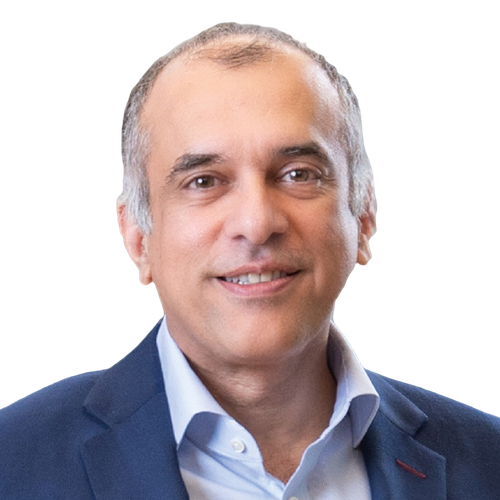


Sunayna Tuteja
Former Chief Innovation Officer
Federal Reserve System
Sunayna Tuteja is a globally recognized innovation leader operating at the nexus of finance, technology, and policy. She most recently served as the first Chief Innovation Officer of the Federal Reserve System, where she built and led the Fed’s innovation agenda across the 12 Reserve Banks and Board of Governors. Her work focused on both the application of emerging technologies within the institution and assessing the policy implications shaping the future of the financial system - including artificial intelligence, digital assets, tokenization, quantum computing, and the future of money and payments.
With more than a decade of experience as a builder, investor, and operator across TradFi, fintech, crypto, and central banking in North America and Asia, Sunayna is known for helping institutions meet the moment - by solving gnarly problems and translating bold ideas into practical execution, shipped outcomes, and measurable business value. Prior to the Federal Reserve, she built the digital assets practice at TD Ameritrade and led major digital transformation initiatives across TD Bank in both Canada and the United States.
A connector of ideas, individuals, and institutions, Sunayna has spent her career creating the conditions for active engagement between the public and private sectors. Her regularly hosted and curated (and over subscribed!) roundtables have yielded not only a forum for spicy conversations, but also positive connections and productive collaboration. When Sunayna is not nerding out about all things innovation, you can find her adventuring the the skies in her Cessna.
Speaking at SFF 2026
-
3:50–4:30pmWed 18 NovFutureMatters StageHall 5, Singapore EXPOPremiumModerator
Technology Rewiring
When Agentic AI Meets Programmable Money, What Comes Next?
-
 Evy TheunisManaging Director & Head of Digital Assets, Institutional Banking GroupDBS
-
 Kash RazzaghiChief Commercial OfficerCircle Internet Group (Circle)
-
 Sanjay SarafChief Product Officer - Fiserv Merchant SolutionsFiserv
-
 Sunayna TutejaFormer Chief Innovation OfficerFederal Reserve SystemModerator
About this session
Three forces are colliding at once—autonomous agents, programmable stablecoins, and real-time rails—and together they could rewrite how money moves entirely. As AI agents begin to transact independently and stablecoins gain regulatory footing, the boundaries between payments, settlement, and currency are dissolving faster than most institutions can react. Learn how agentic payments and stablecoins intersect to enable machine-speed money movement; what infrastructure and compliance shifts this convergence demands; and where the earliest commercial opportunities are emerging.
-
-
3:00–3:30pmThu 19 NovPolicy StageHall 3, Singapore EXPOOpenModerator
Policy Rewiring
Digital Autonomy in AI: Optionality Over Absolute Independence
-
 Prof. Dr. Fritzi Köhler-GeibMember of the Executive BoardDeutsche Bundesbank
-
 Dr. Joseph BreedenChief Executive OfficerCALM XAI
-
 Steven MaijoorExecutive Board Member & Chair of SupervisionDe Nederlandsche Bank N.V.
-
Sunayna TutejaFormer Chief Innovation OfficerFederal Reserve SystemModerator
About this session
No bank can or should build every AI capability itself. The real strategic question isn't build versus buy; it's whether institutions retain meaningful choice over the technology they depend on. As agentic AI begins making decisions that affect customers, capital, and risk, financial institutions must ask: How much digital dependency is acceptable? Can they trust and explain the decision of models they didn't build? What happens when the AI underpinning critical operations is controlled by a single provider?
The panel explores what digital autonomy should look like in the AI era. Rather than arguing for complete self-sufficiency, the discussion focuses on optionality: the ability to choose between providers, maintain control over sensitive data, satisfy regulatory expectations for explainability, and preserve resilient fallback options when business or technology priorities change. The conversation will examine how banks can adopt AI at scale without sacrificing transparency, governance or strategic independence - and why genuine optionality may become one of the industry's most important competitive advantages. -