

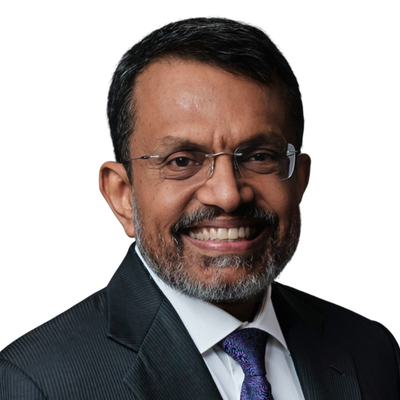
Ravi Menon
Ambassador (Climate Action), Singapore; Chairman of the Board of Directors, Global Finance & Technology Network (GFTN); Former Managing Director, Monetary Authority of Singapore
Global Finance & Technology Network (GFTN)
Mr Ravi Menon has a portfolio of work in sustainability, innovation, and inclusion.
Mr Menon is Singapore’s first Ambassador for Climate Action and Senior Adviser to the National Climate Change Secretariat at the Prime Minister’s Office. He plays a leading role in Singapore’s efforts to foster collective action internationally and transition planning locally towards a low-carbon future. He is also Chairman of the Glasgow Financial Alliance for Net Zero (GFANZ) Asia-Pacific Advisory Board and a member of the GFANZ Principals Group.
Mr Menon is Chairman of the Global Finance & Technology Network, which harnesses technology and fosters innovation for more efficient, resilient, and inclusive financial ecosystems globally. He is also a Trustee of the National University of Singapore (NUS) and Chairman of its Innovation and Enterprise Committee.
Mr Menon is Chairman of ImpactSG, a philanthropy which aims to grow a community of purposeful givers in Singapore and Asia. He is also a Board Member of The Majurity Trust, a charity which deploys cause-based funds for social needs; and a Trustee of the Singapore Indian Development Association, a community self-help group.
Prior to his current roles, Mr Menon served for 36 years in the Singapore Public Service.
As Managing Director of the Monetary Authority of Singapore (2011-23), Mr Menon oversaw monetary and macroprudential policies, reformed the financial regulatory framework, and developed Singapore as a green finance centre and a global FinTech hub. On the international front, he served as Chairman of the Network of Central Banks and Supervisors for Greening the Financial System and Chairman of the Financial Stability Board Standing Committee on Standards Implementation.
As Permanent Secretary at the Ministry of Trade & Industry (2007-11), Mr Menon helped to steer the economy during the global financial crisis. As Deputy Secretary at the Ministry of Finance (2003-07), he oversaw fiscal policy and government reserves.
Mr Menon is a recipient of the Meritorious Service Medal from the Singapore Government, the Distinguished Alumni Award from NUS, and the Distinguished Leadership and Service Award from the Institute of International Finance in Washington.
Mr Menon holds a Master's in Public Administration from Harvard University and a Bachelor of Social Science (Honours) in Economics from NUS.
Speaking at SFF 2026
-
9:20–9:40amWed 18 NovFestival StageHall 1, Singapore EXPOPremium
Geoeconomic Rewiring
The Impact of Geo-Economics in Financial Services
About this session
AI is arriving as finance is being reshaped by geoeconomic fragmentation, technological change, shifting capital, talent constraints and evolving policy. Its effects will not be uniform: the same capabilities that widen access and improve productivity could also concentrate advantage, deepen dependencies and test the resilience of institutions and markets. Drawing on a global view of finance and public policy, this keynote examines where AI could accelerate these ruptures, where it might help bridge them, and what choices will determine the difference. The session asks what must be rewired for financial systems to remain trusted, inclusive and resilient.
-
9:40–10:00amWed 18 NovFestival StageHall 1, Singapore EXPOPremium
Others
The AI and Employment Equation: Balancing Productivity, Displacement, and New Jobs
-
 Dr. Michael SpenceProfessorStanford University
-
 Ravi MenonAmbassador (Climate Action), Singapore; Chairman of the Board of Directors, Global Finance & Technology Network (GFTN); Former Managing Director, Monetary Authority of SingaporeGlobal Finance & Technology Network (GFTN)
About this session
AI is advancing faster than previous waves of technological change, raising a profound economic question: will the productivity gains from AI translate into broadly shared prosperity, or will they accrue disproportionately to capital, highly skilled workers and the companies that control the technology? The answer will shape productivity, employment, wages, inequality and economic competitiveness — and whether governments, businesses and financial institutions are prepared for a labour market in which many of today’s skills are rapidly changing. The conversation will explore what history can — and cannot — tell us about technological disruption, whether AI could break the traditional link between growth and employment, and what policy choices will determine who captures the AI dividend.
-

