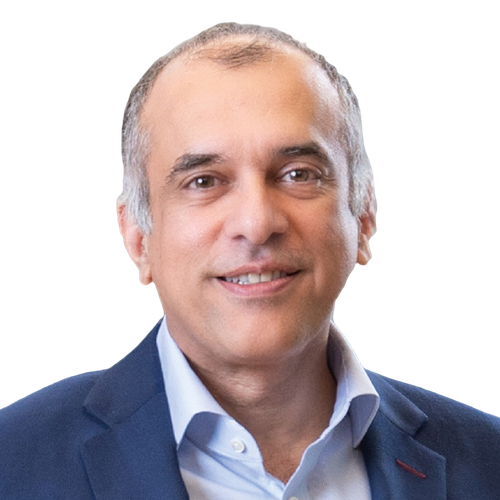


Suresh Shankar
Founder & Chief Executive Officer
Crayon Data
Suresh V Shankar has a condition he calls the stupidity gene. It makes him start companies.
The latest is a new start-up. It builds AI agents that know a bank from the inside — its rules, its risks, its rhythms — and do real work there.
Before that came Crayon Data, in 2012, when few banks said “AI”. Its maya.ai got to know the bank’s customer: 65 million journeys at HDFC Bank, two-thirds of Myanmar’s GDP through KBZ Pay. He still runs it.
Before that, RedPill. An analytics firm in 2000, funded on maxed-out credit cards, bought by IBM in 2009. Before that, advertising and banking in India, and a hunch that data would change marketing.
The gene has no cure. Only persistence.
He graduated from IIM Calcutta in 1985 and has called Singapore home since 1997. For six years he led IIM Alumni Singapore, the largest IIM network outside India. He brought Prime Ministers, Presidents and global CEOs to its stage, and ran BreatheLife during India’s Covid crisis.
He hosts the podcast Slaves to the Algo, where leaders talk about how AI is changing their lives and work. He has also moderated sessions with business leaders such as Ajay Banga, Indra Nooyi and Nandan Nilekani, and with public figures such as Vivian Balakrishnan, K Shanmugam and Shashi Tharoor.
Speaking at SFF 2026
-
3:30–4:05pmThu 19 NovFounders StageHall 2, Singapore EXPOPremiumModerator
Capital Rewiring
When Growth Gets Harder, What Must a Company Simplify to Keep Scaling in 2027?
-
 Prajit NanuFounder & Chief Executive OfficerNIUM
-
 Rob SchimekGroup Chief Executive Officerbolttech
-
 Vince IswaraCo-founder & Chief Executive OfficerDANA
-
 Suresh ShankarFounder & Chief Executive OfficerCrayon DataModerator
About this session
Bigger teams do not automatically build more valuable companies. In its H1 2024 results, Klarna reported a 73% increase in revenue per employee, citing AI-driven efficiencies alongside business growth. But greater efficiency is not the same as sustainable scale. This session explores what companies must simplify to keep growing in 2027: which workflows to automate, what to standardise across markets, where human domain expertise remains indispensable, and which specialised hires still warrant investment. The conversation tests when restructuring unlocks growth and when it strips out essential capability. What should leaders remove, redesign or protect so the business becomes easier to scale, not merely cheaper to run?
-