

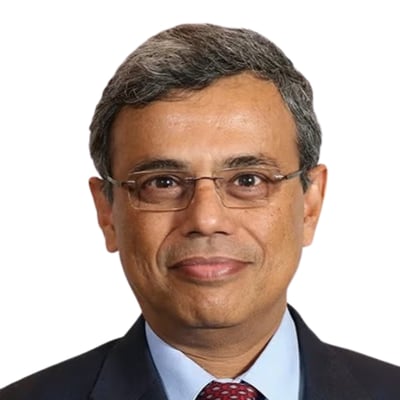
Jawed Ashraf
Chairman, India Trade Promotion Organization; Former High Commissioner of India in Singapore & Ambassador to France & Monaco
Ministry of Commerce and Industry, Government of India
Joined the Indian Foreign Service in 1991 and retired in December 2024. He now writes and comments on international affairs and strategic, defence and security issues. Has served in Indian Missions in Frankfurt, Berlin, Kathmandu and Washington DC and as High Commissioner of India to Singapore from 2016 to 2020 and as Ambassador of India to France and Monaco from 2020 to December 2024.
In New Delhi, he held various positions in the Americas Division, including as the Head of the Division, in the Ministry of External Affairs. He served as Joint Secretary (senior adviser) in the Prime Minister's Office with former Prime Minister Dr. Manmohan Singh and Prime Minister Narendra Modi, with the portfolio comprising foreign policy, defence,, national security council, atomic energy, space and, briefly, science and technology.
Studied Economics at undergraduate level from St. Stephen's College, Delhi, and Management at Master's level from Indian Institute of Management Ahmedabad. The French Government has decided to confer the Commander of the Legion of Honour for his contribution to the development of India-France relations.
Speaking at SFF 2026
-
12:20–12:40pmThu 19 NovFestival StageHall 1, Singapore EXPOPremium
Technology Rewiring
Technology, Capital and Geoeconomics: The Asia-Middle East Corridor
-
 Jawed AshrafChairman, India Trade Promotion Organization; Former High Commissioner of India in Singapore & Ambassador to France & MonacoMinistry of Commerce and Industry, Government of India
-
 Abdulrahman Hesham Al SowaidiChief Executive OfficerQatar Development Bank
-
 Sopnendu MohantyGroup Chief Executive OfficerGlobal Finance & Technology Network (GFTN)Moderator
About this session
Technology and capital are no longer neutral conduits of commerce; they are instruments and pressure points in geoeconomic competition. Yet fragmentation has not ended integration. It has made its terms more contested. The Asia–Middle East corridor crystallises the challenge: how to deepen financial and digital connectivity while managing exposure to strategic chokepoints, incompatible systems and concentrated dependencies. Its test is whether interoperable infrastructure and practical cooperation can turn interdependence into resilience and give shape to a more trusted architecture of finance.
-

